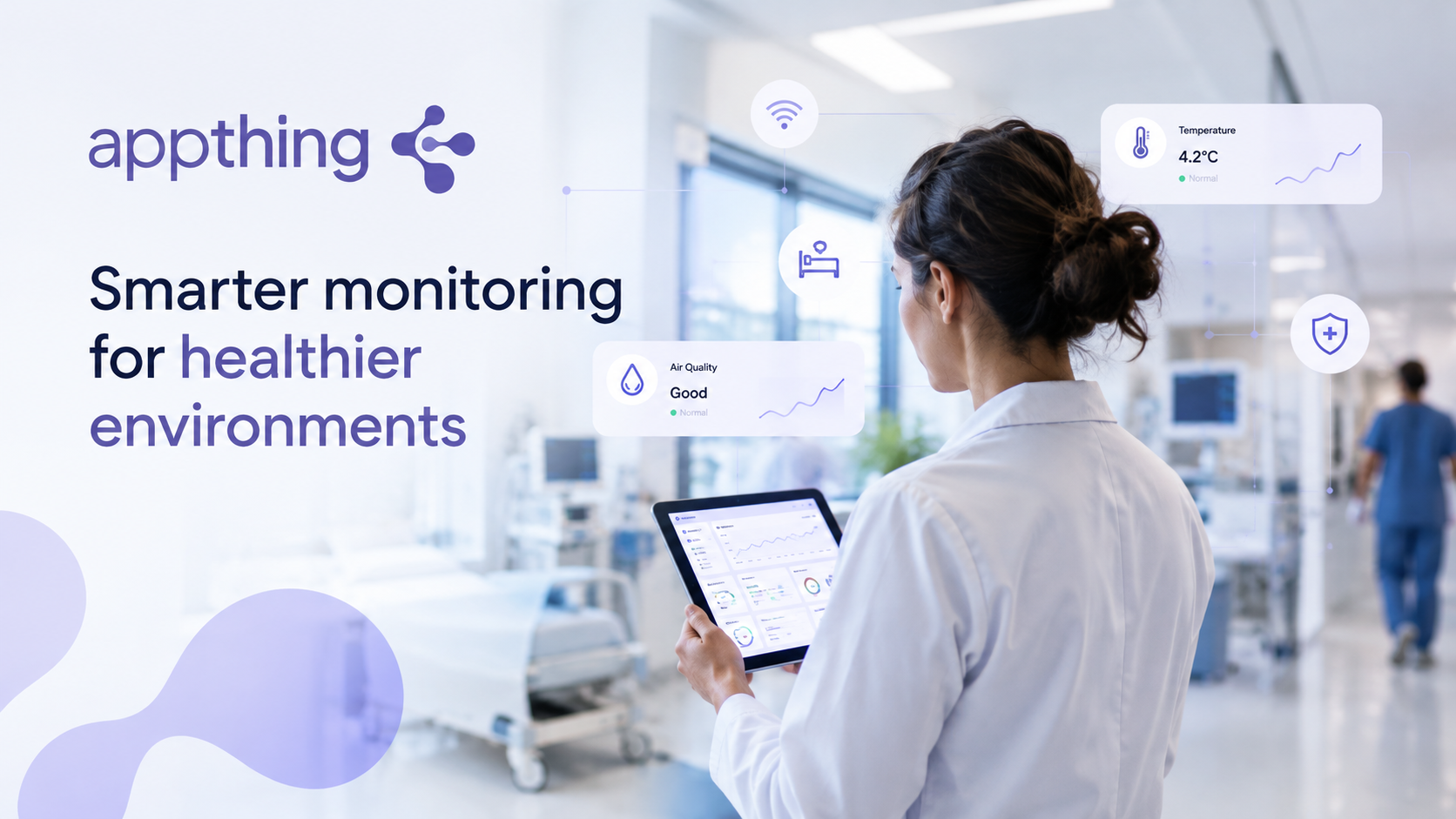
Healthcare facilities operate under constant pressure to maintain safe environments, protect critical assets, support staff, and keep daily operations running smoothly. Yet, many hospitals, clinics, and medical centers still rely on disconnected monitoring systems and manual checks to oversee essential conditions.

AppThing helps healthcare organizations connect data from sensors, devices, and facility systems into a unified IoT platform, providing real-time visibility, actionable insights, and alerts that support more informed operational decisions.

By bringing facility and asset data together, healthcare teams can identify issues earlier, streamline oversight, and make better use of the resources that support patient care.

The Operational Challenges of Modern Healthcare Environments

Healthcare environments are complex, interconnected systems. Clinical activities depend on reliable infrastructure, controlled environmental conditions, available equipment, and the appropriate management of resources across different departments.

Several challenges emerge as a result:

  • Limited real-time visibility: Teams may not have immediate access to changing environmental conditions or equipment status across multiple areas.
  • Reactive maintenance: Without continuous monitoring and historical performance data, potential equipment issues may remain unnoticed until they require intervention.
  • Manual operational processes: Routine inspections and disconnected reporting workflows consume staff time that could be directed toward higher-priority responsibilities.
  • Fragmented information: Separate systems make it harder to identify patterns, coordinate responses, and understand operational performance across a facility.
  • Increasing operational demands: Healthcare organizations must balance efficiency, resource utilization, and environmental oversight while maintaining the conditions required for quality care.

Addressing these challenges requires more than adding individual sensors or collecting additional data. Healthcare organizations need a practical way to connect that information and turn it into operational intelligence.

How AppThing Connects Healthcare Operations

AppThing provides an IoT platform that brings data from connected sensors, devices, and existing systems into a unified operational view.

Rather than requiring healthcare organizations to manage every monitoring solution independently, AppThing connects data sources using technologies such as LoRaWAN, MQTT, and HTTP/HTTPS. This enables teams to work with information from different devices and manufacturers through a centralized platform.

With customizable dashboards, real-time alerts, historical data, and reporting capabilities, AppThing helps healthcare organizations understand conditions across their facilities and identify situations that require attention.

The platform also uses AI-powered analytics to help surface trends, anomalies, and relevant operational patterns. Teams can move beyond isolated readings to better understand changes over time and prioritize their response.

The result is a more connected approach to healthcare facility management, where operational information becomes easier to access, interpret, and act on.

Healthcare Use Cases Supported by AppThing

Healthcare organizations can apply connected IoT monitoring across different areas of facility operations, depending on their infrastructure, priorities, and operational requirements.

Explore the following use cases to learn more:

From Disconnected Data to More Efficient Healthcare Facilities

Connecting operational data creates opportunities to improve how healthcare facilities are monitored and managed.

Improve Operational Visibility

A centralized view of connected devices and facility conditions helps teams understand what is happening across different spaces without constantly switching between independent monitoring systems. Historical information also supports the identification of recurring patterns and changes that may require investigation.

Identify Issues Earlier

Real-time monitoring and configurable alerts help teams become aware of relevant changes as they occur. Instead of relying exclusively on scheduled inspections or manual reporting, staff can receive notifications when monitored conditions fall outside defined thresholds and respond according to established procedures.

Support More Informed Resource Management

Information about equipment status, environmental conditions, and space utilization can help healthcare administrators evaluate how resources are being used. This visibility supports better-informed decisions about operational priorities, maintenance planning, and facility performance.

Simplify Monitoring Across Multiple Facilities

Healthcare networks with multiple buildings or locations need consistent access to operational information. AppThing provides a centralized platform that can support visibility across distributed environments, helping teams review relevant data and maintain oversight as operations grow.

Built Around Your Existing Infrastructure

Healthcare facilities often rely on a combination of established building systems, specialized equipment, and newer connected devices. Replacing these systems to introduce a new monitoring solution can add unnecessary complexity and expense.

AppThing is designed to connect data from different devices and sources without tying organizations to a single sensor manufacturer or communication protocol. Its support for LoRaWAN, MQTT, and HTTP/HTTPS enables organizations to select suitable technologies for their requirements while bringing their data into one platform.

Custom dashboards, role-based access, scheduled reports, and integrations through APIs and webhooks help teams incorporate operational information into their existing workflows.

This flexible approach allows healthcare organizations to explore connected monitoring incrementally, focusing on the operational challenges that matter most before expanding to additional areas.
Ready to see how AppThing can support your healthcare environment?

Schedule a Demo to explore how connected IoT monitoring can help your organization improve operational visibility, streamline facility management, and turn real-time data into actionable insights.

Schedule a Demo
Facility managers are responsible for keeping buildings, equipment, people, and resources working together, often across systems that were never designed to communicate with one another.

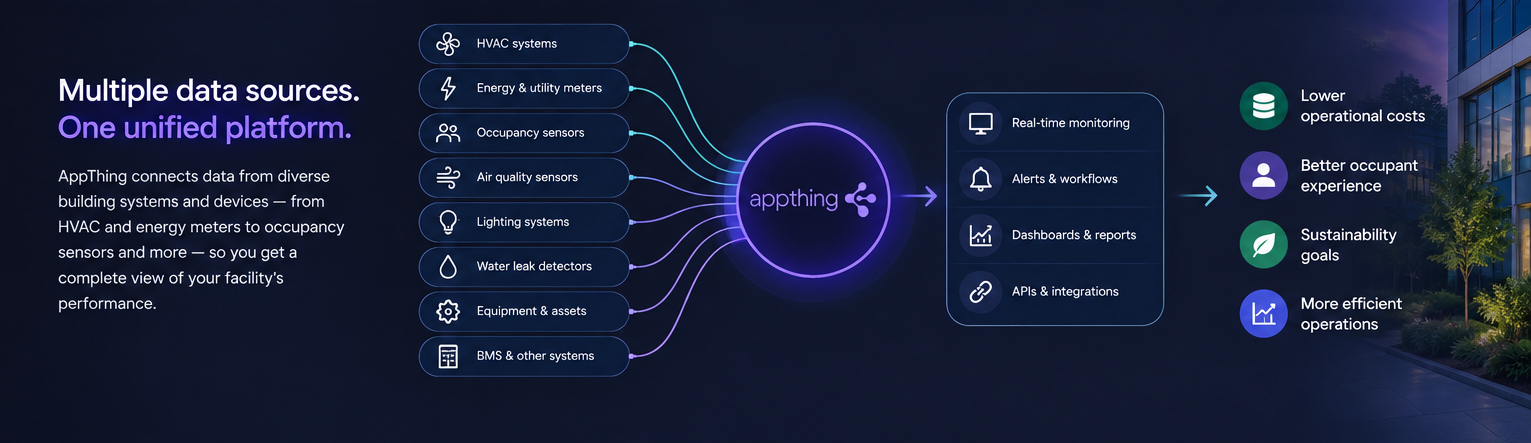
HVAC systems generate one set of data. Energy meters generate another. Occupancy sensors, air-quality monitors, lighting systems, water sensors, and equipment each create their own operational picture.

The challenge is no longer collecting data.

It is turning all of that data into a clear understanding of what is happening—and knowing what to do next.

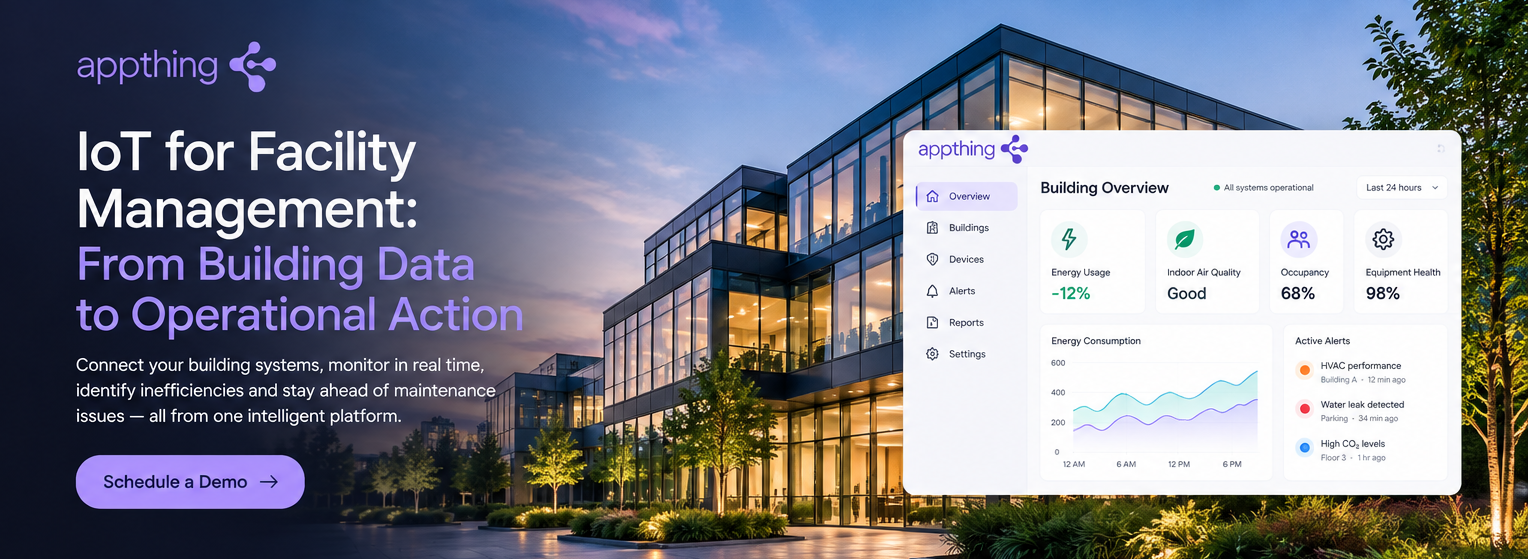
AppThing connects data from diverse devices and building systems into a unified operational environment, giving facility teams the visibility they need to monitor conditions, identify inefficiencies, respond to issues, and make better decisions.

Whether you manage one commercial building, a healthcare facility, a campus, or a distributed portfolio, AppThing helps turn connected building data into operational intelligence.

Schedule a Demo

What Is IoT for Facility Management?

IoT for facility management uses connected sensors, devices, meters, and building systems to collect real-time information about how a facility is operating.

This can include data from:

  • HVAC systems
  • Energy and utility meters
  • Occupancy and motion sensors
  • Indoor air quality sensors
  • Lighting systems
  • Water leak detectors
  • Building equipment
  • Environmental monitoring devices
  • Existing building management systems (BMS)
  • Other connected devices and data sources

The value comes from connecting this information so facility managers can see conditions, trends, and anomalies without having to manage every system independently.

AppThing provides this connected layer by integrating diverse data sources, including LoRaWAN, MQTT, and HTTP devices, into dashboards, reports, alerts, and operational workflows.

Why Facility Managers Need More Than Another Dashboard

Adding another monitoring system does not necessarily solve the visibility problem.

If HVAC data lives in one interface, energy consumption in another, occupancy information somewhere else, and maintenance alerts in a separate workflow, facility teams still have to connect the dots manually.

That creates unnecessary work.

It also makes it harder to answer questions such as:

  • Why has energy consumption increased?
  • Is an HVAC system operating efficiently?
  • Which equipment is showing signs of a potential failure?
  • Are spaces being conditioned when nobody is using them?
  • Is indoor air quality changing in a frequently occupied area?
  • Where is water being used unexpectedly?
  • Which maintenance issues should be addressed first?
  • How are building conditions changing over time?

AppThing brings these different sources together so facility teams can move from isolated measurements to a broader operational view.

The goal is simple:

Connect the data. Understand the context. Identify what matters. Take action.

How AppThing Improves Facility Management Operations

1. Connect Existing Building Data

Facility managers do not necessarily need to replace their existing infrastructure to improve visibility.

AppThing can connect diverse sensors, devices, and data sources, including modern BMS environments and standalone devices.

This makes it possible to build a unified operational layer around existing technology instead of creating another isolated system.

The result is a more flexible approach to smart facility management, one that can evolve as buildings, technologies, and operational requirements change.

2. Monitor Building Conditions in Real Time

Real-time monitoring allows facility teams to see what is happening across their buildings as conditions change.

Instead of waiting for a complaint, scheduled inspection, or equipment failure, teams can receive alerts when important conditions move outside expected parameters.

AppThing supports real-time monitoring and alerts, configurable dashboards, scheduled reporting, and historical analysis.

That visibility can be applied across multiple areas of facility operations.

3. Identify Patterns Before They Become Bigger Problems

Not every operational issue begins with a dramatic failure.

Equipment performance can gradually deteriorate. Energy consumption can increase over time. Occupancy patterns can change. Environmental conditions can shift.

These changes may be difficult to recognize when data is viewed in isolation.

By bringing operational information together, AppThing helps facility teams identify trends and anomalies that deserve attention.

This supports a more proactive approach to facility management and condition-based maintenance.

4. Turn Alerts Into Operational Action

An alert is useful only if someone can act on it.

AppThing is designed to connect monitoring with operational workflows through capabilities such as APIs and webhooks, helping organizations integrate connected-device information with the systems and processes they already use.

That creates a more direct path from:

Data → Context → Insight → Action

Instead of simply telling a facility manager that something changed, the goal is to provide the information needed to understand what changed, why it matters, and what response may be appropriate.


Facility Management Use Cases That Create Measurable Value

The same connected infrastructure can support multiple facility-management priorities.

Rather than deploying a separate solution for every operational problem, facility teams can use one connected platform across different use cases:

HVAC Performance Monitoring

Indoor Air Quality Monitoring

Predictive Maintenance for Building Systems

Equipment Monitoring and Maintenance

Water Leak Detection

Occupancy Monitoring


From One Building to an Entire Facility Portfolio

Facility management becomes increasingly complex as the number of buildings, rooms, systems, and assets increases.

Managing a single facility may already involve multiple operational technologies. Managing a portfolio adds another layer of complexity: different buildings may have different sensors, systems, equipment, and configurations.

A centralized platform can provide a common operational view across these environments.

AppThing is designed to scale from individual deployments to larger enterprise environments, while supporting diverse devices and data sources.

This means facility teams can build their connected environment incrementally.

Start with a specific operational priority.

Connect the relevant data.

Prove the value.

Then expand into additional systems, buildings, and use cases.

Why a No-Lock-In Approach Matters

Facility technology changes quickly.

New sensors become available. Building systems are upgraded. Different manufacturers enter the market. Operational requirements evolve.

A facility management platform should not force teams to redesign their entire technology environment every time something changes.

AppThing’s no-lock-in approach is designed to give organizations flexibility to connect different devices, sensors, and data sources rather than tying the operational environment to a single manufacturer or technology ecosystem.

That flexibility is particularly important for organizations managing mixed environments, legacy systems, and modern connected infrastructure.


See What AppThing Can Do for Your Facilities

Your facility already generates the data.

The next step is turning that data into something your team can use.

Schedule a demo with AppThing to see how your existing building systems, sensors, and operational data can be connected into a unified platform, and how that information can help your team monitor, understand, and improve facility performance.

Schedule a Demo

FAQs

What is a smart facility management platform?

A smart facility management platform connects data from building systems, sensors, equipment, and other operational sources so facility teams can monitor conditions, identify issues, analyze trends, and improve decision-making from a unified environment.

How does IoT improve facility management?

IoT gives facility managers real-time data about building conditions, equipment, occupancy, energy use, and other operational factors. When that data is connected and analyzed together, teams can identify inefficiencies, respond to issues faster, and make more informed maintenance and resource-management decisions.

Can AppThing integrate with existing building management systems?

Yes. AppThing is designed to connect diverse data sources and devices, including modern BMS environments and standalone sensors. Its connectivity supports technologies including LoRaWAN, MQTT, and HTTP.

Can AppThing support predictive maintenance?

Yes. AppThing can collect and monitor equipment and building-system data to help teams identify patterns and changes in operating conditions that may indicate potential maintenance issues. Its facility-management use cases include predictive maintenance of building systems.

Can AppThing monitor occupancy?

Yes. AppThing can use motion, pressure, and access data to monitor occupancy and movement patterns, helping organizations optimize cleaning, HVAC, lighting, staffing, and space utilization.

Is AppThing suitable for multiple facilities?

Yes. AppThing is designed to scale across different operational environments, making it possible to connect and monitor multiple facilities, systems, and device types through a common platform.

Why should facility managers schedule an AppThing demo?

A demo allows facility teams to evaluate how AppThing can work with their specific operational environment, including their existing devices, systems, monitoring requirements, and priorities. Instead of evaluating another generic dashboard, teams can explore how connected data can support their actual facility-management workflows.

Ready to see what your facility data can do?

Schedule a Demo with AppThing:

Schedule a Demo


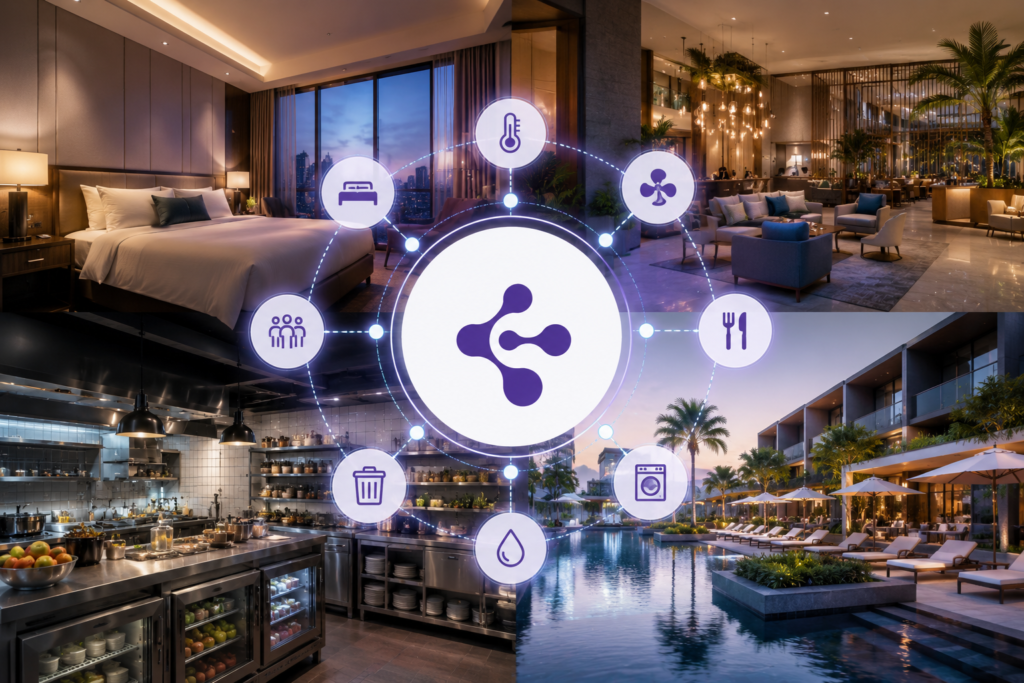
Hospitality businesses manage a wide range of connected systems every day, from guest accommodations and building services to restaurants, commercial kitchens, event spaces, laundry facilities, and other back-of-house operations.

HVAC, lighting, occupancy sensors, refrigeration, kitchen equipment, water usage, waste management, and environmental monitoring all generate valuable operational data. When these systems are managed independently, teams have limited visibility across the property, making it more difficult to coordinate maintenance, optimise resources, and maintain consistent service.

AppThing helps bring these systems together through a single, hardware-agnostic platform. By connecting data from compatible devices and integrating with existing business applications, hospitality teams gain a unified view of their operations across one property or an entire portfolio.


What Is Connected Hospitality?

Connected hospitality is about more than installing smart devices.

It’s about giving operations teams a complete view of how a property is performing.

Rather than monitoring HVAC, occupancy, refrigeration, utilities, maintenance, and environmental conditions through separate applications, AppThing centralises operational data from compatible devices into one platform. This gives engineering, facilities, and operations teams access to the information they need without switching between multiple systems.

Whether managing a hotel, resort, conference venue, restaurant, or food service operation, connected systems help teams respond more quickly, improve coordination across departments, and support day-to-day operations.


Supporting Every Area of Hospitality Operations

Hospitality extends well beyond guest rooms. Every property depends on a combination of guest-facing services and operational infrastructure working together.

Guest Accommodations

Monitor HVAC, lighting, occupancy sensors, environmental conditions, door sensors, and connected room devices from one platform.

Occupancy data can also support room readiness, housekeeping coordination, and energy management when rooms are unoccupied.

Building Systems

Track heating, ventilation, air conditioning, electrical systems, water usage, indoor air quality, and other building infrastructure across guest areas and shared spaces.

Bringing these systems together provides facilities teams with better visibility into the overall health of the property.

Facilities and Maintenance

Continuous equipment monitoring helps engineering teams identify changes in operating conditions and share equipment data with maintenance systems to support preventive maintenance planning.

Food Service Operations

Restaurants, commercial kitchens, cafés, bars, catering services, and banquet facilities rely on refrigeration, freezers, kitchen equipment, and environmental monitoring to maintain food quality and support day-to-day operations.

Connecting these systems allows teams to monitor critical assets from the same platform used to manage the rest of the property.

Events and Conference Spaces

Meeting rooms, conference centres, and event venues require comfortable environmental conditions and efficient facility management.

Occupancy, lighting, HVAC, and utility data help operations teams prepare spaces, manage resources, and maintain a consistent experience for guests and event organisers.

Laundry and Back-of-House Operations

Laundry equipment, storage areas, waste management, and service spaces are essential to daily operations.

Monitoring these areas alongside guest-facing systems provides a more complete operational picture across the property.


One Platform for Multiple Systems

Hospitality organizations often operate equipment from multiple manufacturers, each with its own monitoring application or management system.

Over time, this creates disconnected data, multiple dashboards, and inconsistent operational visibility.

AppThing provides a hardware-agnostic platform that connects compatible sensors and systems into one operational environment. Existing devices can continue to be used while new technologies are added as operational needs evolve.

By centralizing operational data, teams can monitor properties more efficiently without replacing existing infrastructure or becoming tied to a single hardware vendor.


Integrating Operational Data into Existing Workflows

Operational data becomes more useful when it is available in the systems teams already use.

AppThing integrates with business applications through secure APIs, allowing operational information to be shared with maintenance platforms, facility management software, ERP systems, building management systems (BMS), and other enterprise applications.

Examples include:

  • HVAC events shared with a CMMS to support maintenance planning.
  • Occupancy information used to improve housekeeping scheduling.
  • Refrigeration monitoring incorporated into food service operations.
  • Environmental monitoring shared with facilities and compliance teams.
  • Equipment status made available to engineering teams in real time.

Rather than creating another standalone dashboard, AppThing fits into existing operational workflows and helps departments work from the same information


Why Hospitality Organizations Choose AppThing

Hospitality organizations choose AppThing because it helps simplify operations while making better use of existing technology investments.

With AppThing, organizations can:

  • Connect compatible sensors and devices from multiple manufacturers.
  • Monitor guest accommodations, facilities, food service, and back-of-house operations from one platform.
  • Improve visibility across buildings, equipment, and environmental conditions.
  • Share operational data with CMMS, ERP, BMS, and other business systems.
  • Support preventive maintenance through continuous equipment monitoring.
  • Standardise operations across one property or multiple locations.
  • Protect existing hardware investments with a hardware-agnostic architecture.

Traditional monitoring: Multiple monitoring applications | Vendor-specific hardware ecosystems | Separate guest, facilities, and food service systems | Manual sharing of operational data | Limited visibility across multiple properties

AppThing: One central operational platform | Hardware-agnostic architecture | Connected operational view | Integrated with existing business systems | Centralised monitoring across locations


See How AppThing Supports Connected Hospitality

Hospitality operations involve people, buildings, equipment, and services working together every day.

AppThing helps bring those operational systems into one platform, giving facilities, engineering, food service, and operations teams better visibility across their properties while supporting maintenance, energy management, and day-to-day operations.

Schedule a demo to see how AppThing can connect your hospitality operations, integrate with your existing systems, and help your teams work from a single operational view.

Schedule a Demo