
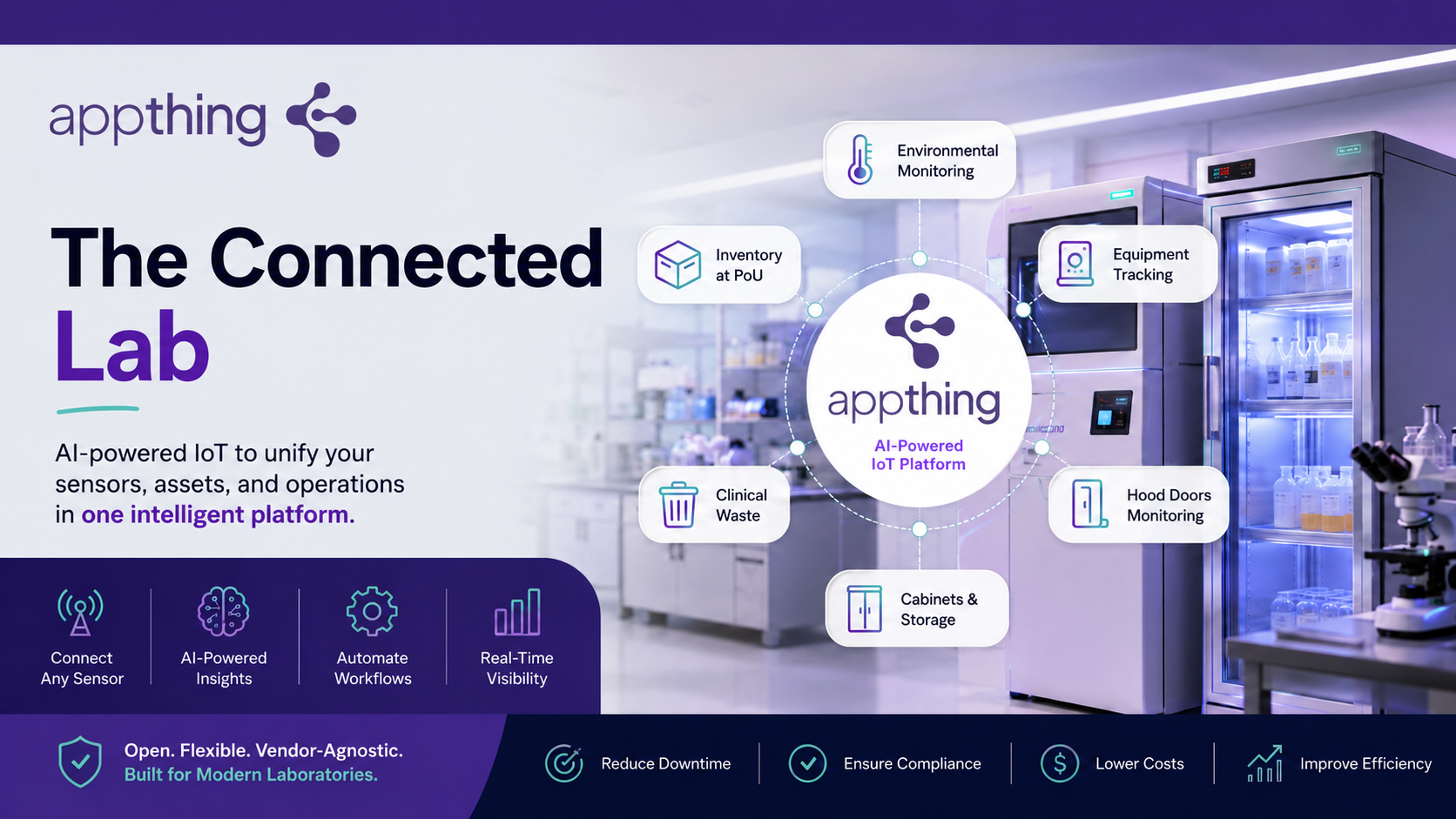
When the Lab Is Running, Someone Is Watching Everything
The scientists are focused on the experiment.
A sample needs to remain within a specific temperature range. An instrument is running. A new batch of materials has arrived. Another experiment is about to begin.
But behind the scientific work, someone has to make sure the lab itself continues to operate.
A lab technician checks whether critical supplies are available. They inspect waste bins. They verify environmental conditions. They check shared equipment and make sure nothing requires attention.
None of these tasks are optional.
But many of them depend on people physically checking things simply because there is no other way to know what is happening.
And that creates a problem.
The more labs, rooms, assets, and operational processes a team is responsible for, the more time gets spent walking, checking, recording, and repeating.
The question is not whether these checks are necessary.
It is whether someone needs to check everything when most of it is perfectly fine.
A Lab Technician’s Day
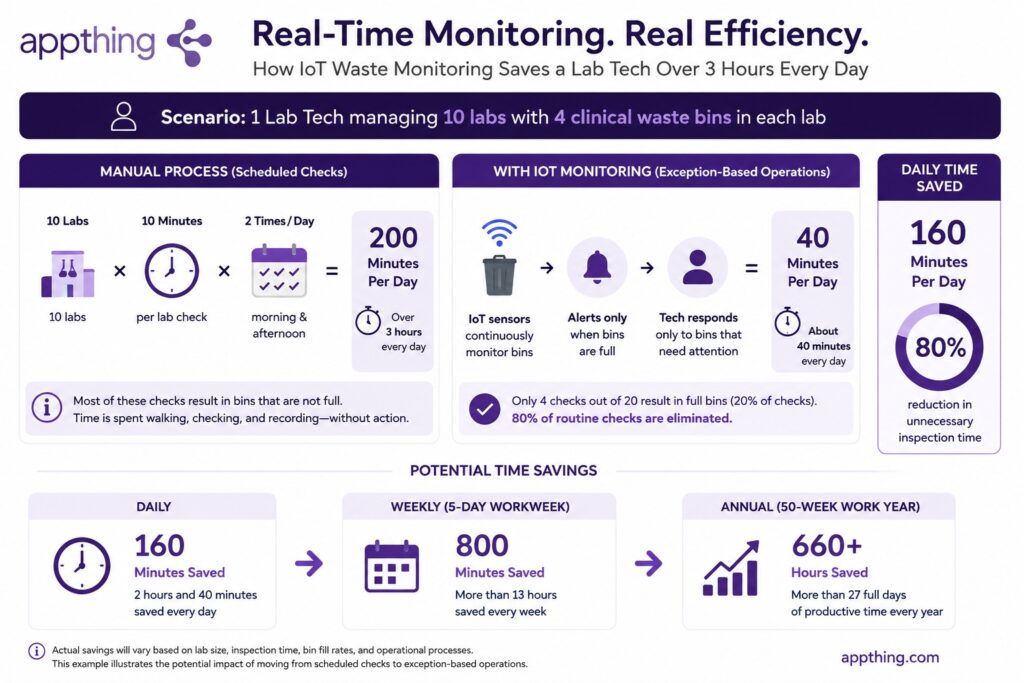
Consider a technician responsible for 10 labs, with four clinical waste bins in each one.
If each lab takes approximately 10 minutes to inspect, and the technician performs the inspection twice a day, that is:
10 labs × 10 minutes × 2 checks = 200 minutes per day
More than three hours spent checking.
And most of those checks may simply confirm that nothing needs to happen.
Now imagine that the technician does not have to walk through every lab to find out which bins need attention.
Instead, the bins continuously report their fill level.
When a bin approaches capacity, the technician receives an alert.
The physical task has not disappeared.
What has disappeared is the need to inspect every bin just to discover which ones require action.
If only four of those daily checks would have resulted in an actual intervention, IoT monitoring could eliminate approximately 80% of the unnecessary inspection activity.
That is the difference between monitoring everything and responding to what matters.
The Same Problem Exists Beyond Waste
Waste is only one example.
The same operational pattern can appear throughout a life sciences environment.
A critical supply can run out between two scheduled inventory checks.
A shared resource can become unavailable when another team needs it.
An equipment problem can begin hours before the next scheduled inspection.
A temperature or humidity condition can move outside an acceptable range between manual checks.
The operational teams cannot realistically be everywhere at once.
And they should not have to be.
This is where connected lab solutions change the way the operation works.
Instead of asking:
“What do I need to check?”
Teams can ask:
“What actually needs my attention?”
From Scheduled Checks to Continuous Awareness
Traditional lab operations often depend on scheduled checks:
Schedule → Walk → Check → Record → Repeat
Connected monitoring changes the model:
Monitor → Detect → Alert → Respond
Sensors and connected devices continuously observe operational conditions in the background.
A technician can respond to a waste bin that actually needs collection instead of checking every bin.
A facilities team can investigate an environmental condition that has moved outside a defined threshold.
A maintenance team can investigate abnormal equipment behaviour before the next routine inspection.
When something changes, the relevant team can be notified.
The objective is not to remove people from the process.
It is to involve them when their expertise is actually needed.
A Simple Shift: From People Checking Everything to People Responding to Exceptions
The biggest operational opportunity isn’t necessarily adding more technology.
It’s changing how teams use their time.
A tech responsible for multiple labs cannot spend unlimited time walking through every room and checking every asset.
But connected monitoring allows the lab to continuously observe those conditions in the background.
The workflow becomes:
Monitor → Detect → Alert → Respond
Instead of:
Schedule → Walk → Check → Record → Repeat
This creates a more efficient operating model where people are involved when their expertise is actually required.
One Operational View Across the Lab
Labs choose AppThing because it helps simplify operations without requiring them to replace their existing As laboratories grow, operational information can become fragmented.
Different sensors may come from different manufacturers. Equipment may use different technologies. Existing monitoring systems and business applications may already be embedded throughout the facility.
Replacing everything is rarely practical.
What teams need is a way to bring these sources of information together.
AppThing connects compatible sensors, devices, and existing operational systems into a centralized platform, allowing labs to monitor different aspects of their operation without replacing the infrastructure they already use.
This can include:
- Clinical waste monitoring
- Point-of-use inventory
- Equipment monitoring
- Environmental conditions
- Energy monitoring
- Operational alerts and notifications
- Maintenance workflows
Instead of treating each of these as a separate monitoring problem, the lab can create a more connected operational environment.
Connecting the Operational Layer
This is where AppThing can become the operational layer connecting these activities.
AppThing can connect compatible sensors, devices, and existing operational systems into a centralized platform, allowing labs to monitor different aspects of their operation without replacing the infrastructure they already use.
The same platform can support use cases such as:
- Clinical waste monitoring
- Point-of-use inventory
- Equipment monitoring
- Environmental monitoring
- Energy monitoring
- Maintenance workflows
- Operational alerts and notifications
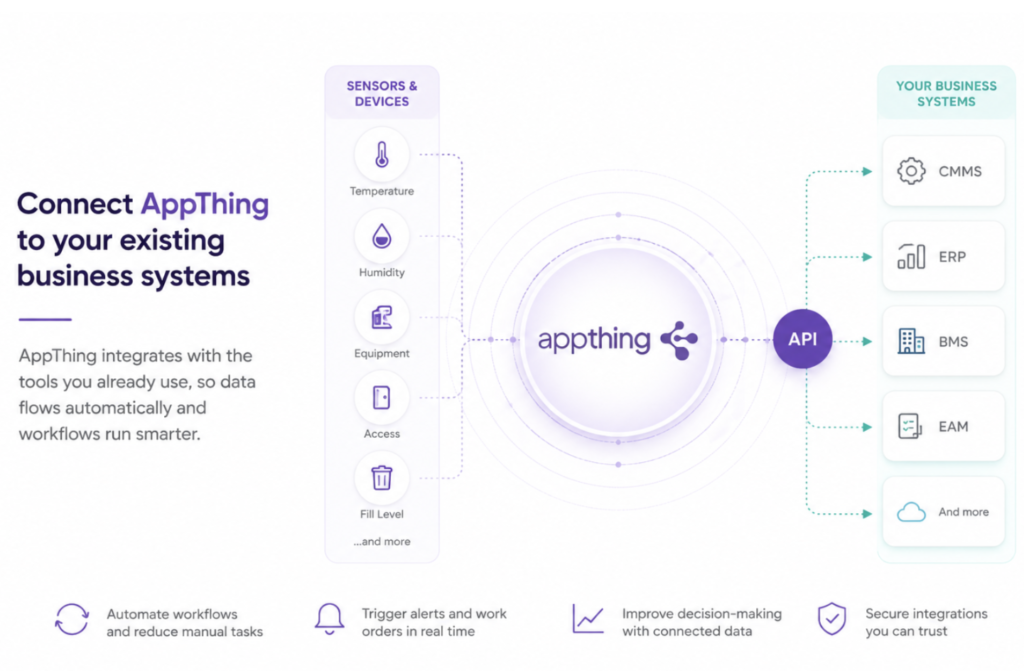
Rather than treating each use case as an isolated system, AppThing provides a way to bring operational data together and make it actionable.
The Business Impact
The business case for connected lab operations is ultimately about what teams can do with the time and information they gain.
In the waste-monitoring example, eliminating 80% of unnecessary inspection activity could represent approximately 160 minutes of potential technician time recovered every day.
Across a five-day workweek, that is more than 13 hours.
Across a 50-week working year, it is more than 660 hours of potential operational time.
The exact impact will depend on the lab, the number of assets, inspection frequency, and actual intervention rates.
But the principle remains:
When teams respond to exceptions instead of manually checking everything, operational efficiency becomes measurable.
See How AppThing Can Improve Lab Efficiency
AppThing connects compatible sensors, devices, and operational systems to provide real-time visibility across the activities that keep life sciences environments running.
From clinical waste and inventory to equipment and environmental monitoring, AppThing helps teams move from routine inspection to exception-based operations while working with the infrastructure they already have.
The goal isn’t simply to connect the lab.
It’s to help the people inside it work smarter.
Schedule a demo to explore how AppThing can help your organization monitor operational conditions, reduce unnecessary checks, and create a more connected lab environment.
Schedule a Demo